Why Different Kids Get Bullied: The Scapegoat Mechanism of School
Orange Cat
Author
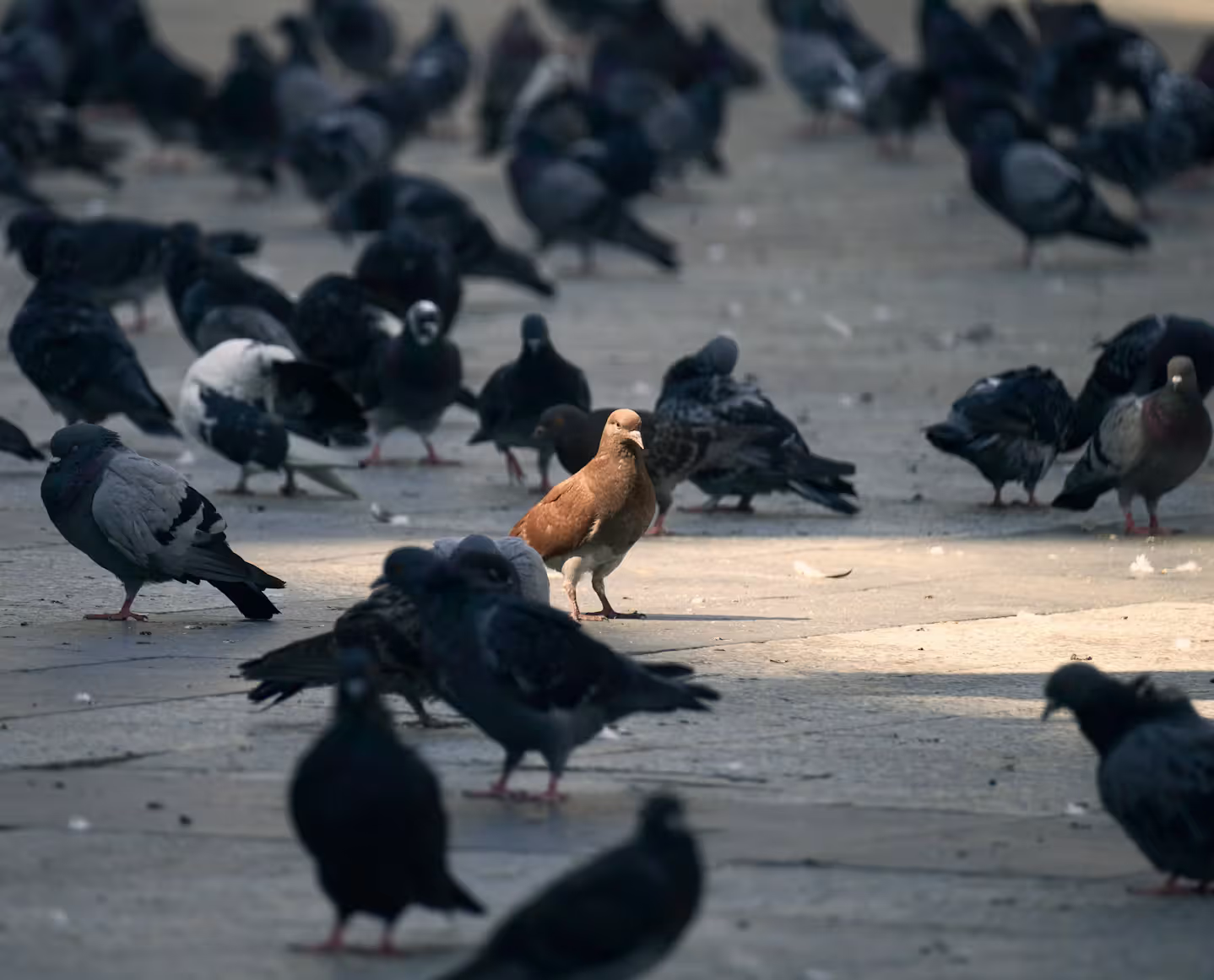
You weren't hated. Most of the time, you weren't being thought of at all until you gave everyone else a reason to notice.
Before I became a nerd, I played all day as a kid, ignored the teacher, and couldn't even see the whiteboard clearly. Different enough, chaos enough, I should've been an easy target. Except I had more energy than anyone wanted to test twice. They learned the consequences firsthand the first time they messed with me.
You might have spent your entire time in school asking why your friends were so mean to you. This happened to a lot of students. It feels like school isn't a safe place to grow up in anymore. The ecosystem is that poor.
Why the Group Needs Someone to Push Out
There's a specific mechanism behind this, and it isn't "kids are mean." René Girard's scapegoat theory, a framework from literary and anthropological theory, not an empirical psychological model, argues that when a group builds up internal tension, rivalry, competition for status, everyone quietly measures themselves against everyone else, that tension has to go somewhere. The group doesn't sit down and decide to unload it on one person. In Girard's account, it happens automatically, landing on whoever is different enough to be visible but not so different they can't be reached [1][2]. Expelling that person buys the rest of the group a temporary, false sense of unity — peace purchased by pushing one person out, without anyone involved being able to name what they just did [1].
That last part is the mechanism's whole trick: the group can't see its own hand in it. It just feels, to everyone inside it, like the excluded kid deserved it somehow. Call it what it actually behaves like once it starts moving as one thing instead of thirty individuals: a herd.
Why "Different" Is the Only Qualification
The kid who gets targeted doesn't need to have done anything. They just need to be different enough to stand out inside a room that's built around one shared tempo, a different pace, a different sense of humor, a different accent, a different way of moving through a conversation. A classroom, like any herd, doesn't evaluate differences before it reacts to it. It detects a mismatch in rhythm and treats the mismatch as wrong. Most kids doing the excluding couldn't actually explain why they left someone out. It's closer to an immune reaction than a decision. That's the scapegoat mechanism showing up before anyone involved is old enough to know what it's called.
Neurodivergent kids — ADHD, autistic, or otherwise wired differently — are one of the clearest, most measurable examples of this pattern. Bullying affects more than 60% of neurodivergent students, and kids with ADHD are bullied at roughly double the rate of their neurotypical classmates [3]. For autistic kids, some meta-analyses put victimization as high as 40–80% [4]. That pressure is a real, documented driver of the homeschooling decision, not just an anecdote: roughly 30% of homeschooling parents cite bullying specifically, and half cite wanting a safer environment overall as their primary reason for pulling a child out of conventional school [5]. Parents aren't imagining the target on their kid's back. The numbers confirm it's there.
The cruelest part is that the same wiring that gets a kid excluded at nine is often the same wiring that makes them sharper or more original later. The herd never seems to be punishing for being worse. It's punishing for being off-tempo, and off-tempo-and-ahead gets treated exactly like off-tempo-and-behind, because the herd was never measuring quality — just sync.
The Herd Got a Bigger Stage
Social media algorithms now run the same mechanism at a different scale. On TikTok, you check in at the trending restaurant or you basically don't get views. The "trending" list is just the digital version of a herd deciding, invisibly, who's in and who's out this week.
And here's the part nobody tells you, which is also the cruelest part: they don't think about you at all. Whoever is following the algorithm, following the conformity, already chose comfort over agency a while ago. There's no leftover attention to spend thinking about you specifically. You're not being hated. You're not being anything. You're just not there.
Taylor Swift's Experience in School
Before Taylor Swift became Taylor Swift, her school life was shaped in part by being visibly different: ambitious, deeply interested in country music, and increasingly serious about something that did not necessarily fit the social environment around her.
In Miss Americana, she admits, "the main thing I always tried to be was a good girl..." She tried to adapt, and play nice, but she got excluded anyway. This is the ultimate tell that the scapegoat mechanism is never actually about your behavior.
For Swift, the exclusion was a quiet, continuous freezing out. She witnessed the reality of this mechanism firsthand when she called several classmates to invite them to the mall. They all told her they were busy, but when she showed up anyway with her mother, she found those exact same girls already walking around together, without her. Exclusion was no longer just a feeling; it was a visible fact.
By twelve, she described herself as "a complete outcast" — sitting at a lunch table full of girls who'd get up and leave the moment she sat down. The same arc runs through her songs: no one wanted to play with her as a kid (Mastermind), life simply became "the outside" (The Outside), school turned into "rolling fake dice" where playing along only earns a hollow prize (Miss Americana & The Heartbreak Prince), and the response was retreat into "secret gardens in my mind" (I Hate It Here). By high school she'd left the traditional track entirely — homeschooled junior and senior year, doing coursework on airport floors between shows, still keeping a 4.0. The system that had no room for her also couldn't contain the way she actually worked once she left it.
The Transformation Part
What Swift did with all of this wasn't just survive it. She turned it into something made, something with her name on it. That's a different move from what a herd tends to do. A herd rarely reflects on itself, in part because reflection is uncomfortable and slow, and the herd is optimized for neither. Whoever joins in has usually chosen comfort over that discomfort; they react, conform, and move to the next target rather than look inward. Writing the experience down — a song, a story, a blog post — is an individual response instead. It means stepping into the discomfort the herd tends to avoid, taking something that happened to you inside a mechanism nobody was steering, and making it into something you authored instead.
That's one response to being scapegoated that tends to work, even if it isn't the only one. You can't out-argue a mechanism that was never reasoning in the first place. But you can take the raw material it left you with and build something that requires exactly the kind of sustained attention the herd was never willing to spend on you to begin with.
A Note on What This Is (and Isn't)
This piece uses Girard's scapegoat mechanism as a lens for a pattern, not a clinical or empirically validated claim. The bullying statistics cited above come from peer-reviewed and survey research; Girard's theory itself is a humanities framework, and the Taylor Swift material is a single public case offered as illustration, not as confirmation. Read the mechanism as one useful way of naming something real, not as a settled scientific explanation for why any individual kid was targeted.
References
[1] René Girard's mimetic theory and scapegoat mechanism — Britannica / Wikipedia
[2] Mimetic Desire & the Scapegoat: Notes on the Thought of René Girard — Critical Legal Thinking
[3] Bullying in Schools Plagues Neurodivergent Students — ADDitude
[4] Autism, bullying, and mental health: a comprehensive systematic review — Frontiers
[5] 50+ Homeschooling Statistics — ThinkImpact
[6] The Story Behind "The Outside" — American Songwriter
[7] Taylor Swift's Untold Story: Childhood Struggles — Celebrity Trends