What Happens When a Child Can't Go Back to International School
Orange Cat
Author
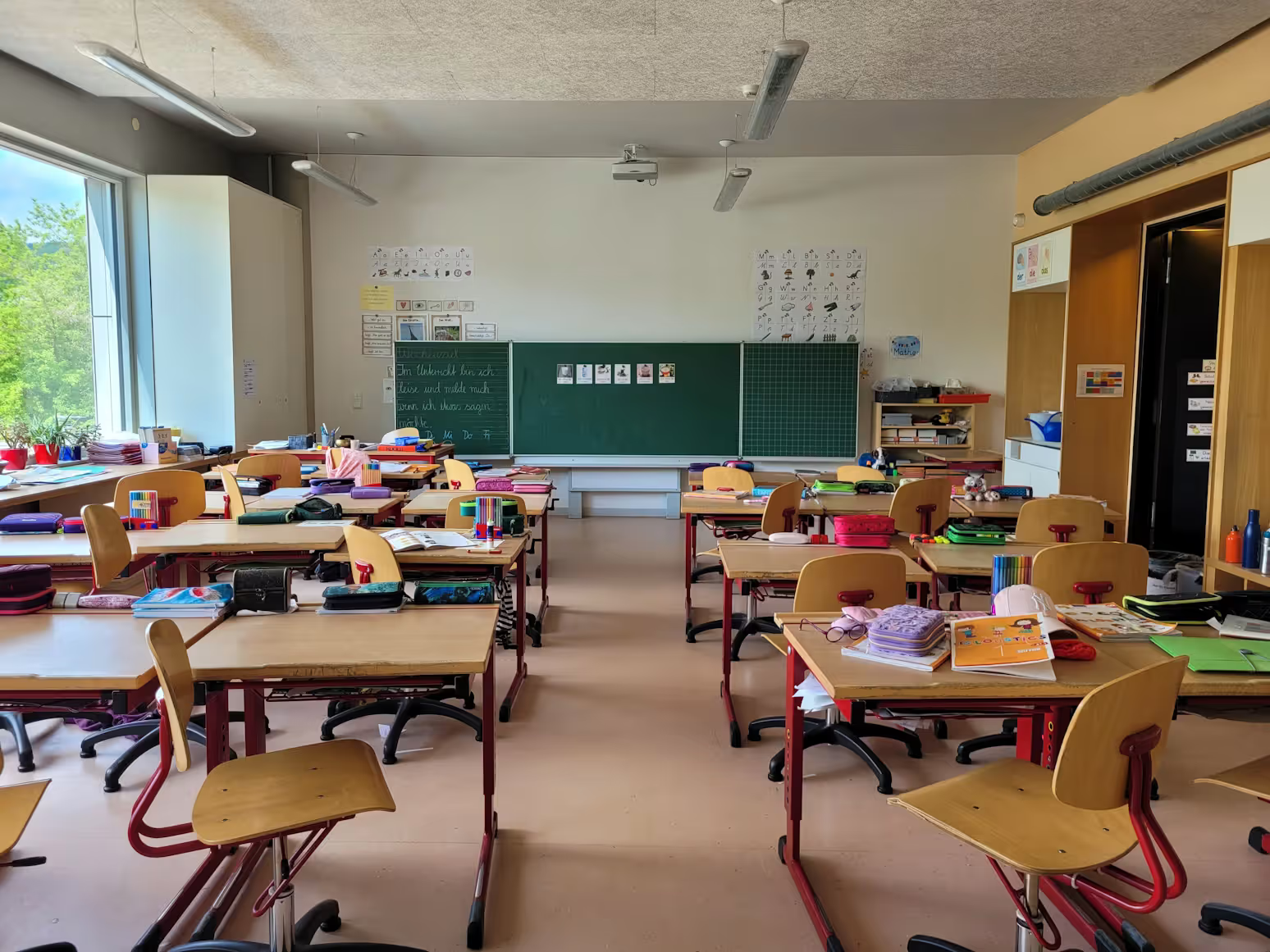
Why the timing of a school transition matters more than the transition itself
What Thai parents are actually buying when they pay for international school is an image: kids rubbing shoulders with the children of wealthy businesspeople, diplomats, NGO staff — a hand-picked, high-achieving "global citizen" peer group assembled from around the world. That's the pitch, anyway. What's actually driving the current boom is narrower and less glamorous: the newly opened schools filling up largely with Chinese students, not the multinational mix the marketing implies.
International schools in Thailand are booming — 249 schools and 77,734 students as of 2024, up 10% in a year, driven largely by Chinese families relocating for work. This piece is actually about [1][2]. But that boom sits on top of a Thai economy that's struggling: growth in 2026 is on track for its slowest pace in three decades outside a crisis year, and a strong baht helps foreign professionals while squeezing Thai household income [3]. Tuition that once felt like a stretch now doesn't add up, and parents are openly comparing notes about pulling their kids out.
In one case, an expat child protested hard enough that his father reversed course and re-enrolled him in international school within a year. Another family in a similar position didn't reverse course, and their child developed depression. Neither outcome shows up in the usual advice about switching schools for financial reasons, which tends to treat the decision as a budgeting problem: this school costs less, the curriculum transfers fine, done. What actually breaks, when it breaks, is rarely the curriculum. It's status.
(A note on sourcing: the cases referenced here come from first-hand observations and personal conversations. Details have been generalized to protect privacy, and no specific schools or families are named.)
Why Losing School Status Hits This Hard
There's a body of research in evolutionary psychology called social rank theory, developed by Paul Gilbert, that treats status loss as a distinct trigger for depression rather than a generic "stressful life event." The theory holds that subordinates and people who have lost rank are at measurably greater risk of depressive symptoms than people who remain high-status or who never had status to lose in the first place — and that perceived rank matters almost as much as actual rank [4][5]. When the goal of attracting others' attention, admiration, and investment is thwarted, hopelessness follows. Some researchers go further: the apathy and withdrawal that show up in depression may function as a kind of evolved shutdown mechanism, a way of accepting a lower position without escalating conflict with people above you in the hierarchy [5][6].
A child transferring out of international school isn't just changing buildings. In their own eyes and their friends' eyes, they are moving down a hierarchy that everyone in that social circle understands and tracks, whether or not any adult ever says so out loud.
Kids Aren't Overreacting — the Research Backs the Panic
This isn't a uniquely Thai or uniquely international-school phenomenon. Research on early adolescents finds that classroom social status is directly tied to depressive symptoms, and that school transitions — moving into a larger, more diverse peer group — force kids to re-establish where they stand all over again [7][8]. One study found that status affects mood mostly indirectly, through how a kid perceives their own standing and through loneliness, not through the raw fact of the ranking itself [9]. That matters here: it means the actual financial reason for the switch is almost irrelevant to how the child experiences it. What predicts distress is whether the child perceives themselves as having fallen, and whether they feel isolated in the new setting. There's also a documented gender split — boys tend to be more sensitive to achievement- and status-related loss, girls more sensitive to rejection and disruption in close relationships [7] — which is worth knowing before assuming one child's reaction will look like another's.
What the "Global Citizen" Environment Is Actually Built On
Part of what makes this loss sting is a belief that international school access is earned — academic merit, talent, a scholarship. In practice, most of what makes schools like NIST feel like a curated "global citizen" environment isn't a scholarship program handing out merit-based seats to deserving outsiders. It's that the tuition, often several hundred thousand baht a year, is quietly paid as part of an employer's expat package for UN staff, NGO workers, and diplomats. The school didn't select those families for character or promise. Their employer wrote the check. Formal need- or merit-based financial aid at schools like this is limited to non-existent [10].
That reframe matters for a child processing the loss. The environment they're grieving wasn't a meritocracy they lost their place in. It was a subsidy that ended. That's not a smaller loss — status loss is status loss regardless of the mechanism — but it's a truer story, and a truer story is easier for both a parent and a teenager to actually believe.
This isn't just one family's math problem, either. By mid-2026, Thailand's private-school sector was carrying over 2.1 billion baht in unpaid tuition, with more than a third of students behind on fees — mostly tied to household financial strain — while regulators were separately moving to tighten oversight of the fast-growing international-school sector itself [11][12].
Buying the Exposure in Doses, Instead of Renting It Year-Round
A year of international school tuition in Bangkok runs anywhere from roughly 350,000 baht at the low end to over a million at the top tier [13]. That same money, spread differently, can fund several years of a few concentrated weeks abroad — a summer program, a language immersion trip, a short exchange — rather than one more year of the same environment stretched thin across twelve months. The "global citizen" exposure doesn't have to be ambient and constant to matter. It can be something the child looks forward to on a calendar, actively chosen, instead of something quietly funded in the background that they only notice when it disappears.
The rest of the year is where homeschooling or a small learning pod earns its place — not as the consolation prize, but as the deliberate, cheaper base that makes the concentrated trip abroad affordable in the first place. Framed to a child as "we're trading year-round for a trip you get to plan," this sidesteps the exact protest dynamic that reversed my friend's decision. It isn't a demotion. It's a different shape of the same thing.
Time Helps — But It Isn't a Plan by Itself
There's real research behind the intuition that time and maturity do a lot of the work that treatment is often assumed to do alone. Meta-analyses of untreated depression estimate that roughly 23% of cases remit within three months, 32% within six months, and 53% within a year, without any medical or psychological intervention [14][15]. That lines up with a pattern plenty of people notice anecdotally in their own social circles — friends and colleagues who went through a rough period tied to family or identity conflict in their teens or twenties, and who describe coming out the other side mainly because they grew up enough to reframe what happened, not because of a specific treatment.
Two caveats matter enough to state plainly. First, spontaneous remission rates are highest for mild-to-moderate cases; they don't mean severe or persistent depression should be left untreated, and a pattern that worked out for some adults looking back isn't a diagnosis tool for a child right now. Second, giving a child two or three years with more parental presence, before deciding whether they're ready to re-enter a peer environment, is a timing decision — not a substitute for paying attention. If sadness turns into a lasting change in sleep, appetite, withdrawal, or self-worth, that's a signal to involve a professional, not a reason to wait longer for maturity to handle it.
What This Actually Means for Parents
- Don't frame the switch as a downgrade in front of the child. "We're building something instead of renting it" survives a protest better than "we can't afford it anymore."
- Give the global exposure a name and a date — a specific summer program, not a vague future promise — so the child has something to hold onto besides what they're losing.
- Watch for the difference between grief and depression. A hard few months is expected. Sustained changes in sleep, appetite, or withdrawal are not something to wait out.
- Don't rush the decision to send them back. The research on peer status suggests re-entry works better when the child has re-established a sense of standing somewhere, not just when the family budget recovers.
References
[1] โรงเรียนนานาชาติในไทยสุดบูม! เศรษฐีแห่ลงทุน เปิดตัวอย่าง 12 ตระกูลใหญ่ รุกธุรกิจโรงเรียนอินเตอร์ — Forbes Thailand. https://forbesthailand.com/other/international-school
[2] จำนวนนักเรียนโรงเรียนนานาชาติเพิ่ม สวนทางนักเรียนไทยลด — Policy Watch, Thai PBS. https://policywatch.thaipbs.or.th/article/education-15
[3] สรุปภาวะเศรษฐกิจไทยเดือนมกราคม 2569 — กกร. (Joint Standing Committee on Commerce, Industry and Banking). https://km.fti.or.th/docs/km/สรุปภาวะเศรษฐกิจไทย-โดย/สรุปภาวะเศรษฐกิจไทยเดือน/
[4] Social rank theory of depression: A systematic review — ScienceDirect. https://www.sciencedirect.com/science/article/abs/pii/S0165032718310280
[5] Rank theory of depression — Wikipedia. https://en.wikipedia.org/wiki/Rank_theory_of_depression
[6] Neuroimaging Evidence for Social Rank Theory — PMC. https://pmc.ncbi.nlm.nih.gov/articles/PMC3347627/
[7] Peer Selection and Socialization in Adolescent Depression: The Role of School Transitions — PMC. https://pmc.ncbi.nlm.nih.gov/articles/PMC3277679/
[8] Being Admired or Being Liked: Classroom Social Status and Depressive Problems in Early Adolescent Girls and Boys — Springer. https://link.springer.com/article/10.1007/s10802-007-9100-0
[9] Peer network Status and Depressive Symptoms Among Early Adolescents — Springer. https://link.springer.com/article/10.1007/s12310-020-09409-3
[10] NIST International School — Tuition & Fees / Admissions. https://www.nist.ac.th/admissions/tuition-fees/
[11] โรงเรียนเอกชนอ่วม ปี'69 จ่อปิดตัว 80 แห่ง สช.ตั้งกรรมการ ออกระเบียบคุม 'ร.ร.นานาชาติ' — แนวหน้า via LINE Today. https://today.line.me/th/v3/article/aGymGZO
[12] ร.ร.เอกชน อ่วม ยอดค้างค่าเทอมพุ่ง 2.17 พันล้าน ฉุดสภาพคล่อง หวั่นกระทบคุณภาพ — Matichon. https://www.matichon.co.th/local/education/news_5753821
[13] International School Fees in Bangkok: 2026 Cost Guide — ischooladvisor. https://www.ischooladvisor.com/articles/schooling-and-school-choice/costs-and-fees-understanding-funding/international-school-fees-bangkok-2026-cost-guide-expat
[14] Estimating remission from untreated major depression: a systematic review and meta-analysis — Psychological Medicine, Cambridge Core. https://www.cambridge.org/core/journals/psychological-medicine/article/abs/estimating-remission-from-untreated-major-depression-a-systematic-review-and-metaanalysis/52961032C5AFAB1C3B2C4E06A652B561
[15] What is the short-term remission rate for people with untreated depression? A systematic review and meta-analysis — ScienceDirect. https://www.sciencedirect.com/science/article/abs/pii/S0165032721010053