The Social Tax of School
Orange Cat
Author

Nerd, popular, crowd, bully — everyone pays a different tax, but nobody escapes it.
I did other kids' homework for years. Not because I was generous. Because letting someone copy my work was the fee I paid so that, when it was time to pick groups, I wouldn't be the one left standing at the front of the room while everyone else already had a table.
That specific moment — not loneliness in general, but the public instant where a room finds out you weren't picked — is, I'd guess, one of the most universal small traumas of growing up. It shows up again in adult life every time a project needs a team and you're not sure you're on one. What I didn't have language for as a kid was that I wasn't just avoiding a bad feeling. I was paying a tax. Everyone was. Just not the same one.
The Four Ways Kids Pay
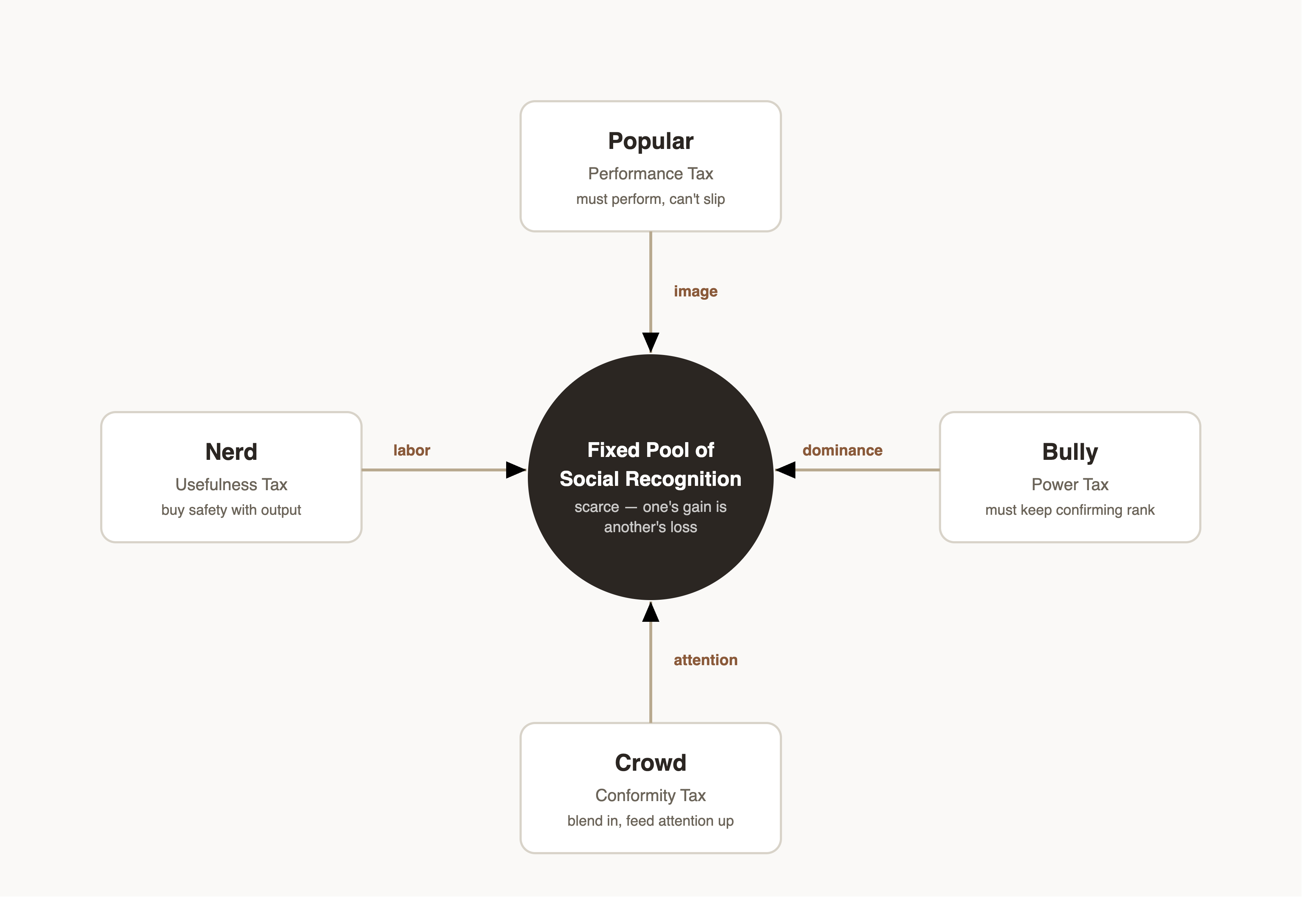
Nerd — The Usefulness Tax
The deal is simple: make yourself valuable enough that excluding you costs something. Homework gets copied, group projects get carried, and in exchange you get a guarantee — not friendship, but a seat. The catch is that this tax has no grace period. Miss one payment — stop being useful for a week — and the deal is void immediately. There's no credit built up from years of good service. You pay every time, or the arrangement doesn't exist.
Popular — The Performance Tax
Status here isn't free either, even though it looks that way from outside. Classic research on adolescent cliques found that roughly a third of students sit in the dominant clique, engaged in constant maneuvering just to hold the position [1]. And holding it is expensive: kids who move up the social ladder see their odds of being bullied rise, not fall — climbing the hierarchy threatens whoever they pass on the way up [2][5]. Being liked by many and being known by many turn out to be different things, and a lot of what looks like popularity is closer to surveillance than affection [3]. The tax is that you can't be caught slipping, ever, in front of the people whose attention is the whole point.
Crowd — The Conformity Tax
Most kids are neither popular nor obviously excluded — they're the majority in the middle, and the price of staying there is staying invisible. Two things enforce this simultaneously. First, if someone in the crowd tries to stand out — in either direction — their own peers tend to pull them back down, a pattern documented well outside of schools as tall poppy syndrome: the tendency to cut down whoever grows past the rest of the row [8][9]. Second, the crowd's job in the wider system is less passive than it looks — popularity has no meaning without an audience paying attention to it, which means the crowd is constantly exporting attention upward to the popular tier just by watching, discussing, and ranking them. The crowd isn't outside the status economy. It's the labor that funds it.
Bully — The Power Tax
Dominance in a kid hierarchy is not a stable asset — it has to be reasserted constantly, because unlike an adult institution, there's no contract, no title, nothing external backing the claim except the last time it was enforced. Social rank theory treats status loss as a distinct trigger for depressive, anxious behavior in the person who loses rank [4], which is the reverse side of the same coin: the person holding rank knows exactly how fragile that position is, because they've likely watched someone else lose it. The tax a bully pays is that the position only exists as long as it's being actively defended — there's no such thing as resting on it.
A Modifier, Not a Fifth Tax: The Rich Kid
Money doesn't buy a fifth way to belong — it buys a discount on the other four. A rich kid chasing popularity can offset the performance tax by hosting, buying, or sponsoring their way into visibility instead of performing flawlessly for it. A rich nerd can offset the usefulness tax because the family's other forms of value to the school (donations, connections) reduce how much personal output has to be extracted every day. Wealth doesn't exempt anyone from the four taxes above — it just changes the exchange rate. Which is why a rich kid can still end up friendless, or bullied, or invisible: money buys a discount, not immunity.
Why Any of This Has to Be a Tax at All
None of this is inevitable. It's a consequence of one design choice: school runs almost all of its social recognition through a single, shared axis — attractiveness, athletic ability, academic standing, and charisma, which tend to travel together anyway. When everyone is ranked on the same axis, positions are scarce by definition. Someone is always at the top, which means everyone else is, structurally, not.
Compare that to how a bee and a flower trade. The exchange is positive-sum: the bee gets nectar, the flower gets pollinated, and neither has to take anything away from a third party for the trade to work. Nature runs on thousands of overlapping niches rather than one leaderboard. School status doesn't work like that, because it never diversified the axis. One leaderboard, limited seats, and a tax gets levied on everyone trying to hold a seat on it.
There's a real, tested body of research behind the exclusion side of this too. Being ostracized — even briefly, even by strangers in a rigged computer game — reliably produces measurable pain and drops in reported belonging, self-esteem, and sense of control, across more than a hundred replications [6][7]. That's the stakes underneath all four taxes above: nobody is paying to feel good. They're paying to avoid a very specific, well-documented kind of hurt.
The Monopoly on Belonging
The seats bought with these taxes are more fragile than they look. Nothing accrues. The moment you stop paying the tax, the moment you stop being useful, the seat disappears.
Compare this to the bee and the flower. Their relationship is true symbiosis. The bee operates in an open ecosystem; if one flower offers nothing, it simply flies to another. But humans do not live in open systems. We live in closed systems. Even as adults, our ecosystems are small, often reduced to just family, friends, and colleagues. A company is just the adult version of the classroom terrarium. You might only work there for a period of time, but you are a captive audience while you do. You cannot simply fly to the next flower when it takes six to twelve months to find a new job.
What Actually Breaks the Cycle
The instinctive fix is to add more leaderboards which are a chess club leaderboard, an art club leaderboard, so more kids can win something. That helps a little, but it's a smaller version of the same machine. Any group of same-age kids competing on a single axis, even a niche one, will eventually produce its own popular tier, its own crowd, its own tax.
The more durable fix removes the leaderboard requirement entirely: a group where membership isn't earned through daily performance, and where the people setting the tone aren't only same-age peers. A gardening club where a parent or a teacher is simply present changes the axis that gets rewarded — effort and curiosity start to count for something, not just coolness — and it changes who's judging: adults evaluating a mixed-age group don't rank kids on the same scale kids use on each other. Cross-age settings dilute the leaderboard by default, because a seven-year-old and a fourteen-year-old were never going to be ranked against each other in the first place.
Membership that isn't conditional on winning that day's status contest is, as far as I can tell, the only version of "belonging" that doesn't come with a tax attached. It's not a new leaderboard. It's the removal of one.
The Outlier: Proof the Cycle Can Be Left
There's a fifth kind of kid who doesn't fit the four taxes above, and it's worth naming precisely because of why. The outlier isn't the kid who lost the game. That's just an unlucky nerd or an excluded member of the crowd. The outlier is the kid who stopped playing it, usually because they already have standing somewhere the four-axis leaderboard doesn't reach: a sport outside school, a tight extended family, an online community built around a niche skill, a homeschool co-op. They can walk past the whole status economy without paying into it, not because they're braver than everyone else, but because their sense of worth was never priced in that currency to begin with.
The outlier isn't an exception to the tax system. They're the existence proof that the tax is optional once belonging comes from somewhere else — which is the whole argument for building more of those "somewhere elses" on purpose, rather than waiting for a kid to stumble into one by luck.
A Note on What This Is (and Isn't)
The four-tax framework above — usefulness, performance, conformity, power — is my own synthesis, not a named theory from the literature. I built it out of research that is real and tested (social rank theory, clique-hierarchy studies, ostracism research, tall poppy syndrome) but the four-way split itself hasn't been validated as a typology anywhere I could find. Treat it as a lens, not a finding. If someone has a closer-fitting framework already published, I'd genuinely like to see it.
References
[1] Adler, P. A. & Adler, P. — Peer Power: Preadolescent Culture and Identity, summarized in Popular Kids — Psychology Today
[2] Being popular doesn't protect kids from bullying in high school — NPR
[3] The Illusion of Popularity — Psychology Today
[4] Social rank theory of depression: A systematic review — ScienceDirect / Rank theory of depression — Wikipedia
[6] Williams, K. D. (2007). Ostracism. Annual Review of Psychology. PDF — Hendrix College
[7] The Ordinal Effects of Ostracism: A Meta-Analysis of 120 Cyberball Studies — PLOS ONE
[8] Feather, N. T. (1989). Attitudes towards the high achiever: The fall of the tall poppy. Australian Journal of Psychology. ResearchGate