The Relationship Bottleneck
Orange Cat
Author

Family is assigned, colleagues are assigned, friends are whoever stood nearby. Three channels carry everything, which is why everything is stuck.
Try this. Think of something you actually want to do, not a hobby, something with a result attached. Preserve seeds. Build a thing. Fix something in your neighborhood. Now go through the people you could do it with.
You will find three groups: family, friends, colleagues. That's the whole list. And the moment you hold that list up against the mission, you notice the problem. None of these people were selected for this. They were selected by birth, by proximity, or by an employer.
This is a bottleneck, and it's worth being precise about what kind. It isn't that we know too few people. It's that there are only three channels available, all of them carrying traffic they were never designed for, and no fourth one to open. Everything you might want to build has to squeeze through relationships that formed for entirely different reasons which is why most of it never gets attempted at all.
The Three Channels, and Why They're All Congested
Family is assigned at birth. Colleagues are assigned by whoever signs the payroll. Friends feel chosen, but mostly they aren't. They're the residue of proximity, whoever happened to be in your dorm, your office, your neighborhood, at the age when you still had time to accumulate people.
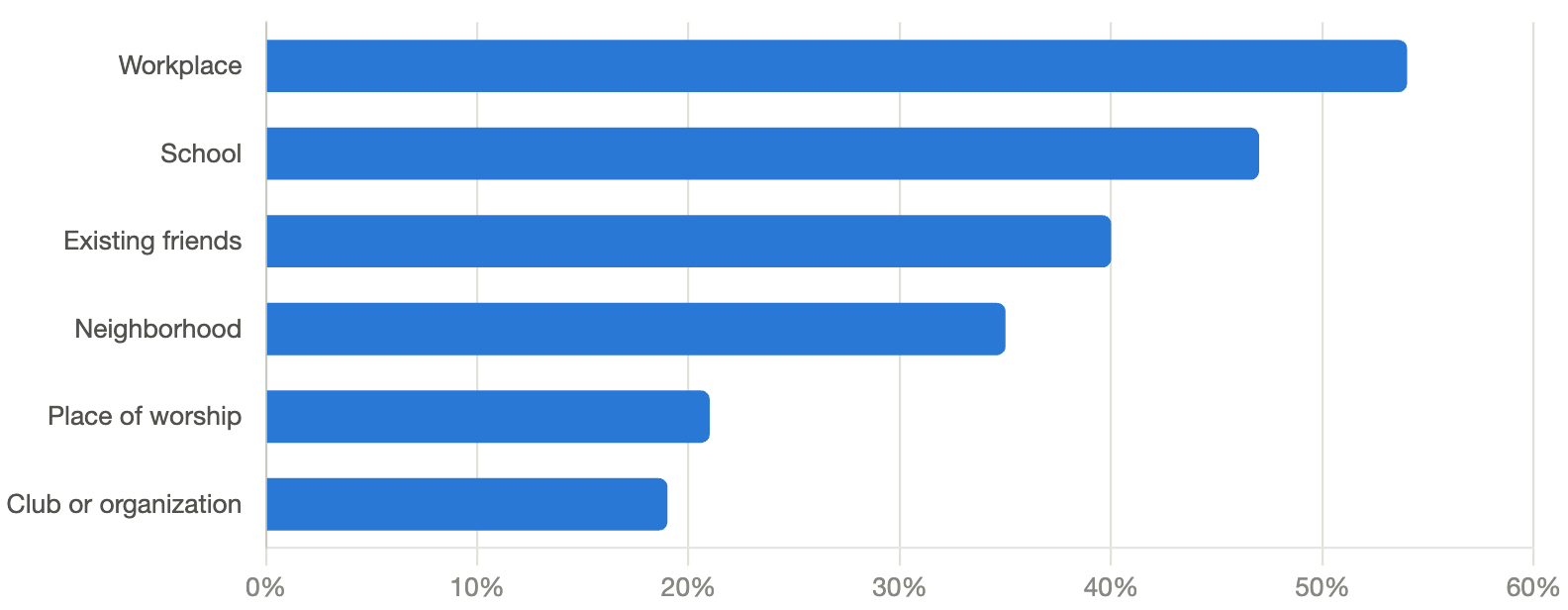
The data is blunt about this. When Americans are asked where they met a close friend, the workplace comes first, at 54 percent — ahead of school (47 percent), existing friends (40 percent), the neighborhood (35 percent), a place of worship (21 percent), and a club or organization (19 percent) [1].
Read that again. The single most reliable place adults make close friends is the one place where they did not choose a single person in the room. Someone in HR did.
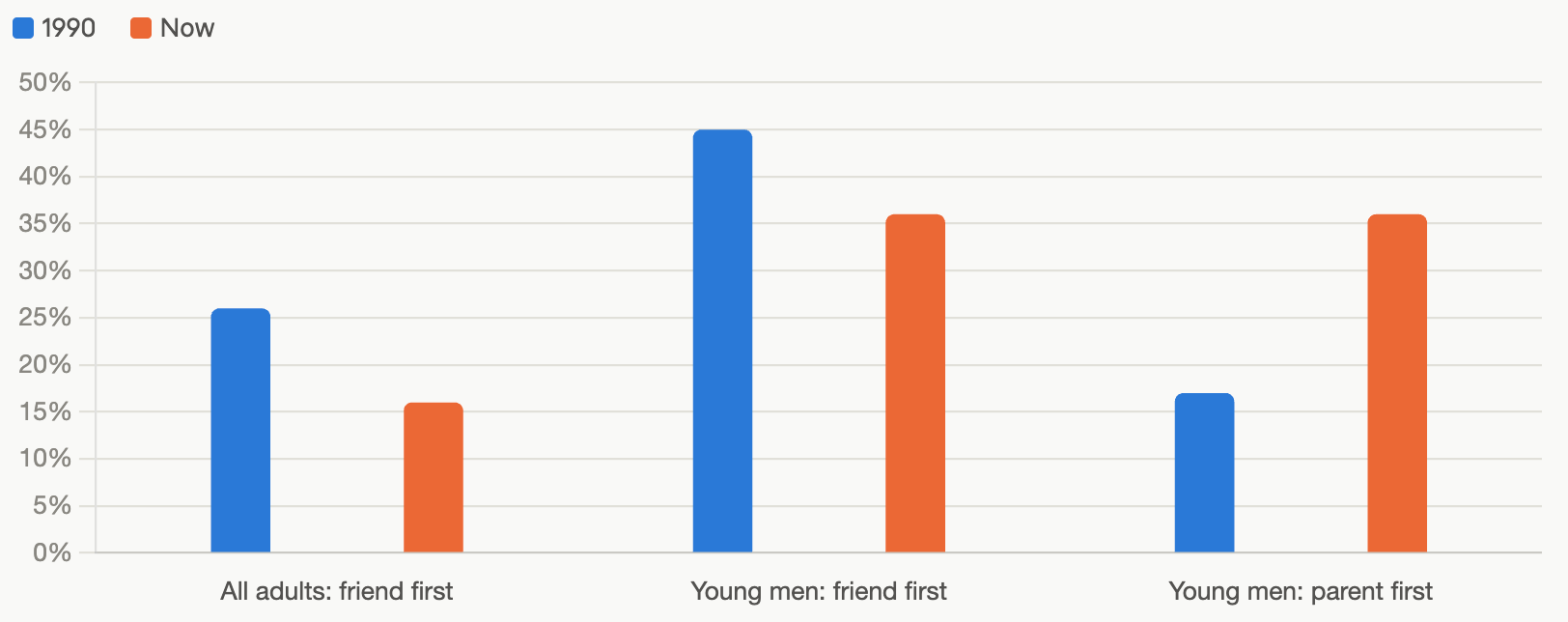
And we lean on that shrinking pool less and less. Only 16 percent of Americans say a friend is the first person they talk to about a personal problem, down from 26 percent in 1990. Among young men the shift is starker: 36 percent now go to a parent first, up from 17 percent in 1990 — a year when 45 percent said they'd go to a friend [1].
All three channels are full, and they're full of people who arrived by accident.
Where the Fourth Channel Used to Be
There was a fourth channel once. It was called a club.
At school and university, you could join something organized around a purpose, with a structure attached, a term, and other people who had also opted in on purpose. Then you graduate, and it quietly closes. Nothing replaces it.
Yes, we still have badminton. We still have the cycling group. But those fix a temporary experience, not a mission. Nothing fails if you don't show up on Sunday. No one is waiting on your part. Nothing gets built, and nothing is left over afterward. Shared experience is not the same thing as shared work, and only one of them produces something you can point at.
The Friendship Gap (1990 vs. Present)
Metric | 1990 | Present | Shift |
No close friends at all | 3% | 12% | Quadrupled |
3 or fewer close friends | 27% | 49% | Nearly doubled |
10 or more close friends | 33% | 13% | Dropped by 60% |
Has a best friend | 75% | 59% | Declined |
Meanwhile the base has been eroding underneath all of it. Close friendship has collapsed since 1990: 49 percent of Americans now report three or fewer close friends, up from 27 percent. Twelve percent report none at all, up from 3 percent. The share with ten or more fell from 33 percent to 13 percent. Having a best friend fell from 75 percent to 59 percent [1]. In-person socializing dropped more than 20 percent between 2003 and 2023, and among unmarried men and people under 25, the decline exceeds 35 percent [2].
Sociologist Ray Oldenburg called the places where this used to happen "third places" — the informal spots outside home and work where people gather. He was already describing them as a diminishing feature of American life decades ago [3].
I'd put it slightly differently. The third place didn't only disappear. It lost its task. What we're missing isn't a café. It's a reason to be in one together.
Why the Internet Didn't Fix This
You might argue we can just start a Facebook group.
Here's what actually happens. Someone opens the app to post the schedule, and the feed gets them first. Twenty minutes later they've read four arguments they had no stake in and forgotten what they came for. That isn't a personal failure. Social media is built to retain your attention on the platform as long as possible. The global average is around two hours and twenty minutes a day, with TikTok alone taking roughly 95 minutes per daily active user [4].
Notice what all that time buys in terms of actual relationships: 8 percent of Americans say they made a close friend online [1]. Clubs and organizations, which most adults have stopped attending entirely and which get a couple of hours a month at best from the ones who haven't, produce more than twice that. The channel nobody funds outperforms the one that has everyone's waking attention. (That survey was fielded in 2021, when in-person groups were shut down and online was all anyone had. The gap held anyway.)
So the problem with a Facebook group isn't that it does nothing. It's what it's good at. Social networks make it easy to sign up and impossible to sustain coordination over months with a budget, roles, and a deliverable. They are recruitment infrastructure being used as operations infrastructure.
There's a deeper mismatch too. A platform is optimized for retention; a mission is optimized for completion. A mission group that succeeds should be able to end. No platform can want that for you.
Friendship Is Expensive. Missions Aren't.
Family and friends eat your bandwidth. Not because they're bad relationships because that's what those relationships are. They require ongoing, undirected, open-ended attention, and the demand is never specified, so it can never be satisfied. The people who try hardest to keep every high-demand relationship alive at once are the ones who burn out, and it usually doesn't end well.
This is the bottleneck again, seen from the other side. When three channels carry all the traffic, each one runs overloaded. The bandwidth problem and the bottleneck problem are the same problem.
A mission group asks for something different. You owe a specific thing, by a specific date, to a specific group of people. Outside that, you owe nothing. The demand is named, so it can actually be met.
Which raises the obvious objection: can a group of people who aren't friends actually work together?
The research says yes, and it named the thing thirty years ago. Meyerson, Weick and Kramer described what they called swift trust, a form of trust that appears in temporary teams built around a common task, with a finite life span, members who have little history together and little prospect of working together again. Traditional trust is assumed to build slowly through shared history. These teams don't have that and function anyway. Trust is extended up front, based on role and competence, then verified through action. What holds it together isn't relationship history, it's normative action: mutually agreed standards that the group actually keeps to [5].
That's the mission group, described in an academic paper in 1996. Not friendship converted into work, but trust manufactured from structure.
I'll flag the criticism, because it matters. Swift trust is fragile. It erodes fast without ongoing communication, and some researchers argue it isn't really trust at all, just a risk-management strategy standing in for it [5]. I think that's fair, and it's exactly why the next section exists. Swift trust doesn't survive on goodwill. It survives on the rules being real.
In this kind of group, we don't need to be friends who maintain a relationship. We just have to complete the mission.
The Five Conditions
If a mission group runs on structure rather than history, then the structure has to be decided before anyone starts. Five things, and the order matters.
Condition | What you decide up front | What it prevents |
1. Term | How long this runs, and when it ends | Open-ended obligation; a group that outlives its reason and can't be left |
2. Mission | Why we are here, written down, specific enough to be finished | Drift. "Support the community" is not a mission; "collect, grow out, and document forty local seed varieties this year" is |
3. Policy and boundaries | What we do and don't do, what's expected of a member, what falls outside the group's business | Every request becoming a fresh negotiation, decided by whoever is most tired |
4. A team to handle disagreement | Who resolves conflict, named in advance, and never one person | One volunteer becoming the permanent villain of every hard conversation |
5. Financial policy | How money comes in, who can spend it, and how anyone who contributed can see where it went | Suspicion filling the space that information left empty |
Term goes first, and it's the one most groups never set at all.
A defined endpoint is what makes everything below it enforceable. It's what lets someone commit without signing up for the rest of their life. It's how a group avoids becoming root-bound — old wood, same seats, nobody able to leave and nobody able to enter. And it's the reason nobody has to perform friendship indefinitely to stay in good standing. In the swift trust research, a finite life span isn't a limitation on the group. It's a defining property of the kind of group that works this way [5].
One caveat on all of this. Writing the rules on day one does not make them real. Research on norms in temporary groups found that normative influence emerged through interaction over time rather than from rules set in advance [6]. Your actual policy is whatever the group tolerates in month two. The document just gives you something to point at when you decide to stop tolerating it.
A Note on What This Is
Mission groups already exist. Open source projects, mutual aid networks, volunteer fire crews, bands, church committees. I'm not claiming this is impossible or unprecedented — the opposite. My claim is narrower: there's no default path into one after school ends. The ones that exist mostly formed by luck, through someone who happened to know someone.
The appetite is not the problem. I want to be honest about a number that cuts against a simpler version of this argument. Formal volunteering in America hasn't collapsed — it's risen. In 2023, 28.3 percent of Americans, more than 75 million people, volunteered through an organization, contributing nearly 5 billion hours. The rate rose 5.1 percentage points in a single year, described as the largest recorded expansion of formal volunteering [7]. Add informal helping and it's over half the country.
So people clearly want this. What they're doing is joining institutions that already exist, most of them built decades ago. Almost nobody is starting a new one, with five people and a defined term, from nothing. The shortage isn't willingness. It's formation.
And I have a stake in this. I run a platform for building communities, and I've just written several thousand words arguing that people need better ways to build them. That's convenient for me. It might still be true, but weigh it knowing who's making the argument.
You don't widen a bottleneck by pushing harder on the channels you already have. You open another one. Five people, a term, and something worth finishing is enough to start.
References
[1] Cox, D. A. (2021). The State of American Friendship: Change, Challenges, and Loss — Survey Center on American Life, May 2021 American Perspectives Survey (n=2,019). 1990 comparisons from Gallup; note the survey's own caveat on telephone vs. online administration.
[2] American Time Use Survey data on declining in-person socialization, 2003–2023 — see The Death of Partying in the U.S.A. and Americans of all ages are spending less time socializing
[3] Oldenburg, R. — The Great Good Place. Summarized at Ray Oldenburg — Wikipedia
[4] Average Time Spent on Social Media Per Day — DemandSage
[5] Meyerson, D., Weick, K. E., & Kramer, R. M. (1996). Swift Trust and Temporary Groups. In Kramer & Tyler (eds.), Trust in Organizations: Frontiers of Theory and Research, Sage, 166–195. Sage / summary at Swift trust theory — Wikipedia
[6] Postmes, T., Spears, R., & Lea, M. (2000). The formation of group norms in computer-mediated communication. Human Communication Research, 26, 341–371.
[7] AmeriCorps & U.S. Census Bureau (2024). More than 75.7 Million People Volunteered in America — Current Population Survey Civic Engagement and Volunteering Supplement.