What I've Learned From Homeschooling in Thailand, as an Outsider
Orange Cat
Author

Why Thai families opt out for homeschooling, how it compares to the US, and the hidden gaps in learning at home.
Time is one of the last true luxuries. Not money, not status — time. And the one thing a parent can actually give a child, more than any tutor or curriculum, is time spent with them.
I keep coming back to an odd parallel from machine learning. In pretraining, the first “teacher” model matters enormously — it's what a student model learns from before it ever forms its own judgment. There's a growing body of research on weak-to-strong generalization: a student model, trained under a weaker teacher, can end up surpassing that teacher's own capability [1][2]. But the reverse is also true — if a model gets corrupted early, from bad data or a flawed foundation, the more sensible move is often to start over with a new model rather than try to retrain the damaged one.
Humans aren't machine learning models, but the metaphor holds better than I'd like it to. Parents — especially mothers, in the earliest years — are a child's first teacher model. And those very first years do an outsized amount of work in shaping how a child comes to see the world.
I'm not a homeschooling parent myself. What I have is years of lurking in Thailand's homeschool network — reading, watching, and eventually interviewing some of the people who lead it. This is what I've learned, as an outsider looking in.
(A note on sourcing: some of what follows comes from conversations with homeschool leaders and parents in these networks. I didn't ask for permission to quote them individually for an article, so I'm writing from general patterns and observations rather than attributing specific claims to specific people.)
Why Thai Parents Choose Homeschool
From what I've observed and heard across several homeschool network leaders in Thailand, four reasons come up again and again.
1. Their child is neurodivergent — autistic, ADHD — and was bullied in mainstream school.
This isn't a small or rare pattern. Surveys of neurodivergent students in the West put the numbers in stark terms: more than 60% report being bullied, and autistic students are estimated to be up to three times more likely to be bullied than their neurotypical peers [3]. Thailand doesn't have equivalent large-scale published data that I could find, but the reason shows up constantly in homeschool parent stories here — a child who didn't fit the mold of a 40-student classroom, wasn't given support, and was targeted for it. Homeschooling, in these cases, isn't usually a first choice. It's what's left after school stopped being safe.
2. Their family sent them to international school, then couldn't keep affording it.
This one is more Thailand-specific than people realize. Thailand's education system has been under real financial strain: over 600,000 children left school early in 2025 alone, and a 2025 survey by the Equitable Education Fund found that 22.2% of respondents said they couldn't continue their studies simply because they couldn't afford tuition [4]. Private and international schools are sitting on more than 2 billion baht in overdue fees, mostly because regulations bar them from expelling students over unpaid tuition at the primary level — so schools absorb the loss instead [4]. Some families I've come across didn't leave international school by choice. They left because the bill stopped being sustainable, and homeschooling became the bridge.
3. The child is talented — sport, music — and the family wants to build a schedule around that, not around a school bell.
These are usually the families with the most intentional setup: curriculum built loosely around government requirements, with the rest of the day carved out for training or practice. It's less about rejecting school and more about school not being able to flex around a competitive athlete's or a young musician's actual schedule.
4. The parents want to actively shape their child's worldview — a “global citizen” mindset, usually taught through an English-medium program.
This group tends to be the most philosophically driven. They're not escaping a bad experience; they're opting into a specific one, usually English-heavy, deliberately international in outlook, sometimes stitched together from online curricula and in-person tutors.
How This Compares to the US
From what I understand of the US homeschool conversation — and I say this as someone watching from outside that context too — the dominant driver seems different: a loss of trust in institutions. Autism and bullying show up there as well, including a striking rise in cyberbullying on social platforms [3], but underneath a lot of American homeschool decisions is something more ideological — a sense that the institution itself can no longer be trusted, and that families would rather build their own small, trusted network from scratch.
Thailand's reasons feel more circumstantial than ideological: a child who was hurt, a bill that got too big, a talent that needed room, or a specific worldview a family wanted to instill. The American version, at least as I've come to understand it, is closer to an exit from a system parents no longer believe in.
The Social Cost: Neighbors, Gossip, and Learning to Ignore It
In the older generation especially, homeschooling parents in Thailand describe the same experience: neighbors gossip. If a child isn't in uniform, isn't at the bus stop, isn't visibly “in school,” people assume the worst — that something is wrong with the child, or the family. The advice that gets passed down from more experienced homeschool parents to newer ones is consistent: don't try to explain yourself to the neighborhood. It's not worth the energy, and it rarely changes anyone's mind.
What a Homeschool Day Actually Looks Like
The pattern I've seen described most often is built on trust rather than rigid instruction. Both parent and child design the curriculum together, loosely mapped to government requirements, and the day tends to follow something like this:
- Morning: helping around the house, part of the family's normal routine
- Late morning (around 10–11am): structured learning begins
- Afternoon: about an hour of homework, then the rest of the day is open — helping a parent with work, sport, or other activities
In total, most families I've come across land around 3–4 hours of actual study time a day. That number tracks closely with what the research on US homeschooling shows: structured learning time in the 2–4 hour range is common across most grade levels, and some research suggests one-on-one instruction can cover in 2–3 hours what a traditional classroom takes 6–8 hours to get through [5]. It isn't less education. It's less overhead.
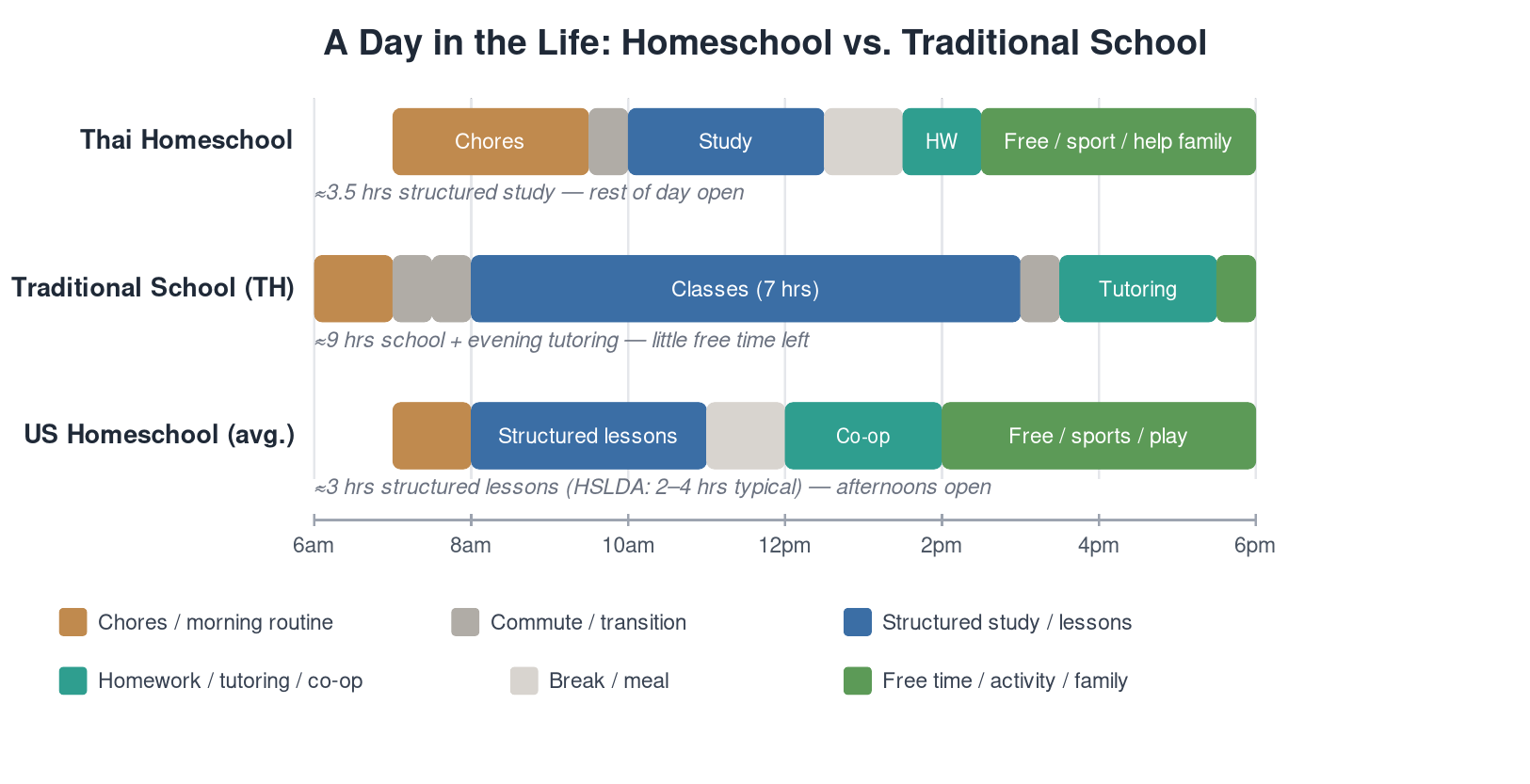
A day in the life: Thai homeschool, traditional Thai school, and average US homeschool
Thailand doesn't have equivalent published data — I haven't found any local study measuring homeschool outcomes against school-based peers. What I've heard, anecdotally, is that scores swing more widely than they would in a standardized classroom setting — which makes sense given how much a homeschool education depends on the individual family.
What stands out most: most homeschooled kids I've encountered in Thailand speak fluent English, and they carry a kind of unhurried, mentally secure quality that's hard to describe — a slow-life mindset, not chasing trends the way school-going peers often do.
For a Western reference point on a similar structure, look at Ballerina Farm's Hannah Neeleman — a hired teacher comes to the family's property a few times a week to run lessons in a converted barn, following a set curriculum, while the rest of the day is built around farm work and family life [6]. It's a wealthier, more resourced version of the same basic shape I've seen in Thai homeschool families: a structured core of study, and a much larger block of the day given to real-world responsibility and unstructured time.
A Day at Ballerina Farm
- Early morning: farm chores before anything else — the kids help milk the cows and tend the animals, since Hannah has said everyone on the farm has a job [9]
- Mid-morning: the older kids head to the schoolroom — a converted barn on the property — where a hired teacher runs lessons a few times a week on a Mormon-Christian curriculum [10]
- Rest of the day: back outside for farm work, animals, and family time — cooking, riding, and helping with the family business, which the Neelemans treat as part of the kids' education as much as the lessons are [9][10]
A Quick Look at the Research on Academic Outcomes
Thailand has no equivalent data yet, but the US does, and it's worth a quick mention. Rudner (1999) tested over 20,000 homeschooled students nationwide and found their achievement scores ran meaningfully ahead of their public- and private-school peers [11]. A later study by Clemente (2006), comparing homeschooled, public-schooled, and Catholic-schooled students who went on to Christian colleges, found the homeschooled group came in with the highest average SAT scores and, once enrolled, kept the highest GPAs of the three [11][12]. None of this controls for family income or background, which likely explains a good chunk of the gap — homeschooling families may simply skew more advantaged — but the pattern was consistent enough to be worth flagging.
A 2026 review by the National Home Education Research Institute (NHERI) — a homeschooling advocacy group, worth reading with that lens in mind — puts a number on the broader pattern: across 24 peer-reviewed or representative-sample studies spanning three decades, 62% found homeschooled students outperforming their institutionally schooled peers on achievement tests, with the remainder showing mixed or negative results [13]. NHERI's review also pushes back on a common critique — that homeschool studies don't control for family income or education — arguing that several of the studies it surveyed do, and that homeschoolers still come out ahead even then. That claim is worth treating with some skepticism given who's making it, but it lines up with the individual studies above.
The Real Weak Point: Working With Other Kids
The problem that comes up over and over, once kids get old enough to notice it, isn't really friendship. Homeschooled kids find friends — siblings, extended family, church groups, Discord, homeschool meetups. What's harder to replicate at home is something more specific: the daily experience a school gives kids by default, of being placed in a room with peers and having to work as a group — coordinate, divide up tasks, negotiate disagreements, show up for each other on a deadline. That's a different skill from friendship, and it doesn't happen automatically when the "classroom" is your own living room.
Here's a place I'll push back a little, though: a same-age classroom isn't actually how the real world works. No workplace is 25 people born within twelve months of each other — adult collaboration happens across a wide range of ages and experience levels, new hires next to veterans, teenagers and retirees on the same volunteer crew. By that measure, a well-run co-op, where kids of different ages work together on a shared project, is arguably closer to real-world teamwork than a standard same-age classroom is. It's not the same thing schools provide, but it may be the more useful version of it.
This is where the US homeschool world is structurally ahead: co-ops. American homeschool co-ops range from a handful of families meeting for enrichment classes to networks with hundreds of children, often meeting weekly through the school year, with parents rotating who teaches what [7]. Thailand has a version of this, but it's thin — a handful of groups, nowhere near the density or maturity of the American co-op scene.
Most of the leaders and parents I've spoken with recognize this gap. Their instinct is that homeschooled kids eventually need structured, cross-age collaborative work with other kids — project-based, not just supplementary. It's part of why, as a platform serving this niche, we've been thinking seriously about how to actually bridge that: not just connecting homeschool families to each other, but giving kids real practice working alongside others, across a wider range of ages than a typical classroom gives them.
Practical Advice for Thai Parents Considering This
If you're Thai and looking at homeschooling seriously: go through the proper legal channel. Contact your local education area office and submit your education plan — including your educational philosophy, curriculum plan, assessment method, and evidence of your own capability to teach [8]. Homeschooling in Thailand has been legally recognized since the National Education Act of 1999, formalized further under Ministerial Regulation No. 3 in 2004 [8]. Doing it properly, on paper, from the start, is what keeps the door open for your child to enter university later — assuming university is still the credential that matters in five or ten years, which is its own open question.
A few communities worth knowing, from what I've seen of the Thai homeschool network:
- Homeschool Network (Facebook group) — a large community, around 113,000 members, that's been run for years by the same steady leadership maintaining and moderating it.
- HomeSchool Talk พูดคุยทุกเรื่องเกี่ยวกับการทำโฮมสคูล — led by experienced homeschool parents, with a recurring Zoom call every Wednesday, 20:30–22:00, where leaders show up consistently to answer questions and support newer families.
- Chiang Mai Homeschooling (Facebook group) — the largest community for expat families specifically, closely tied to the Chiang Mai Homeschool Co-op, which runs one of the more established co-op structures in the country.
Where This Might Be Headed
My read is that the Thai government's underlying priority is keeping students inside the mainstream public system — homeschooling is tolerated as a path for children who are neurodivergent or who have a specific, internationally competitive talent, not as a mainstream alternative. I've heard, though I can't independently confirm it yet, that the requirements are likely to get stricter, not looser, going forward.
That's a hard thing to hear if you're a parent already deep into this path. But every problem I've seen described in this network has had the same answer underneath it: it gets solved when families work together, not when they try to solve it alone.
This is an outsider's view — I want to be honest about that. I don't have a child in this system. What I have is years of watching, some conversations, and a lot of respect for the parents doing the actual work. If anything here is wrong or incomplete, I'd rather be corrected by the people living it than be the last word on it.
Sources
- Provable Weak-to-Strong Generalization via Benign Overfitting
- High-dimensional Analysis of Knowledge Distillation: Weak-to-Strong Generalization and Scaling Laws
- Bullying in Schools Plagues Neurodivergent Students: ADDitude Survey
- Policy vs reality: The true cost of Thailand's 'free' education / Bangkok Post — Overdue tuition fees at private schools over B2bn
- Homeschoolers May Need Less Instructional Time than Traditional School Students — HSLDA
- All About Ballerina Farm's Kids
- What Are Homeschool Groups? — HSLDA
- Homeschooling in Thailand — Complete Guide for Families (2026)
- Hannah Neeleman — Wikipedia
- Inside Ballerina Farm: Everything to Know About Hannah and Daniel Neeleman's Children — Parade
- Kids Who Are Homeschooled Score Better Than Those That Go to Public Schools — r/UnpopularFacts
- Clemente (2006), Homeschooled Students' Academic Achievement at Christian Colleges — ERIC
- An Overview of Research on Homeschool Students' Academic Achievement and Test Scores — NHERI